
If you’ve ever wondered why a Chinese massage session feels so different from a Swedish or deep tissue treatment, you’re not alone. The distinction goes far deeper than technique, it’s rooted in fundamentally different views of the human body and what healing actually means.
At Li’s Massage Therapy and Reflexology in Centennial and Highlands Ranch, Colorado, we specialize in Chinese massage and see firsthand how clients react when they experience these techniques for the first time. Many come in expecting the familiar long strokes of a Western massage, only to discover something entirely different, and often, surprisingly effective for issues they’ve struggled with for years.
So what exactly sets Chinese massage techniques apart from Western styles? Let’s break down the key differences, from the philosophical foundations to the hands-on methods, so you can make an informed choice about which approach might work best for your body.
Philosophical Foundations Behind Each Approach
Before we even get into the physical techniques, we need to talk about what’s happening beneath the surface, the belief systems that shape how practitioners approach your body.
Traditional Chinese Medicine and Qi Energy
Chinese massage is grounded in Traditional Chinese Medicine (TCM), a system that’s been refined over thousands of years. At its core is the concept of Qi (pronounced “chee”), the vital life energy that flows through your body along specific pathways called meridians.
According to TCM, health problems arise when Qi becomes blocked, stagnant, or imbalanced. A skilled Chinese massage therapist doesn’t just work on sore muscles: they’re attempting to restore the proper flow of energy throughout your entire system. This is why you might feel effects in unexpected places, a therapist working on your feet could be addressing issues related to your kidneys or liver, based on meridian theory.
The body is viewed holistically in this tradition. Your physical symptoms, emotional state, and even the season of the year all factor into how a treatment is approached. It’s a fundamentally different lens than most of us grew up with.
Western Anatomy and Muscular Focus
Western massage, by contrast, developed primarily from European traditions and is firmly rooted in anatomical science. Practitioners study muscle groups, connective tissue, the skeletal system, and how these structures interact mechanically.
When you get a Swedish massage or deep tissue treatment, your therapist is thinking in terms of muscle fibers, trigger points, and physical tension patterns. The goal is typically to increase blood circulation, reduce muscular adhesions, and promote relaxation through direct manipulation of soft tissue.
Neither approach is “right” or “wrong”, they simply operate from different starting points. Western massage excels at addressing specific muscular complaints, while Chinese massage aims to treat the whole person by working with the body’s energy systems.
Key Techniques in Chinese Massage
Chinese massage encompasses several distinct modalities, each with its own methods and applications. Here are the main techniques you’ll encounter:
Tui Na is perhaps the most widely practiced form of Chinese therapeutic massage. The name translates roughly to “push and grasp,” which describes the core movements. Practitioners use their fingers, knuckles, palms, and sometimes elbows to apply rhythmic pressure along meridian lines. Unlike the flowing strokes of Swedish massage, Tui Na often involves more focused, penetrating techniques designed to break up energy blockages.
Acupressure applies firm pressure to specific acupoints, the same points targeted in acupuncture, but without needles. By stimulating these points, therapists aim to influence Qi flow and address everything from headaches to digestive issues. We often incorporate acupressure into our sessions at Li’s Massage Therapy and Reflexology when clients are dealing with particular health concerns.
Reflexology operates on the principle that your hands, feet, and ears contain reflex points connected to every organ and system in your body. By applying targeted pressure to these areas, practitioners can supposedly influence corresponding parts of the body. It sounds unusual if you’re unfamiliar with it, but many clients report profound relaxation and relief from chronic conditions.
Cupping and Gua Sha, while not strictly massage, often accompany Chinese bodywork sessions. Cupping uses suction cups to draw blood to the surface, while Gua Sha involves scraping the skin with a smooth tool. Both aim to release stagnant energy and improve circulation.
What ties all these techniques together is the underlying philosophy: we’re not just addressing symptoms, but working to restore balance to the whole system.
Common Western Massage Methods
Western massage traditions have produced their own diverse array of techniques, most of which focus directly on muscular and soft tissue manipulation.
Swedish Massage remains the foundation of Western bodywork. Developed in the 19th century, it uses five primary strokes: effleurage (long gliding movements), petrissage (kneading), friction, tapotement (rhythmic tapping), and vibration. The overall effect is relaxing, with improved circulation and reduced muscle tension as primary benefits.
Deep Tissue Massage takes things further by targeting chronic muscle tension deep below the body’s surface. As we offer at our practice, deep tissue techniques involve slow strokes, direct pressure, or friction movements across the muscle grain. It’s particularly effective for clients dealing with long-standing pain patterns or recovering from injuries.
Sports Massage adapts techniques specifically for athletes, focusing on areas of the body that are overused or stressed from repetitive movements. Pre-event massage helps prepare muscles for activity, while post-event work aids recovery.
Trigger Point Therapy zeroes in on specific “knots” in muscle tissue that refer pain to other areas of the body. A tight spot in your shoulder might actually be causing that headache you can’t shake. Therapists apply sustained pressure to these points until they release.
Myofascial Release works on the fascia, the connective tissue that surrounds muscles and organs throughout your body. When fascia becomes restricted, it can cause pain and limit mobility. This gentle technique applies sustained pressure to gradually restore movement.
All of these methods share a common thread: they approach the body as a mechanical system and work to improve its physical function through direct manipulation.
How Treatment Goals Differ
Understanding what each tradition is actually trying to accomplish helps clarify why the experiences feel so different.
Chinese massage aims to restore energetic balance. When you come in for a session, we’re assessing not just your physical complaints but your overall pattern of imbalance. Are you experiencing excess or deficiency? Is energy stagnating in certain areas? Treatment is designed to address root causes, not just surface symptoms. This often means working on areas of your body that seem unrelated to your primary complaint, because in TCM, everything is connected.
The expected outcome isn’t simply relaxation (though that certainly happens). It’s improved vitality, better organ function, emotional equilibrium, and prevention of future health issues. Many clients report improvements in digestion, sleep quality, and mood alongside relief from physical pain.
Western massage targets specific physical outcomes. When you book a deep tissue or Swedish session, the goals are more straightforward: reduce muscle tension, improve range of motion, increase blood flow, lower stress hormones. Success is measured in tangible physical improvements.
This isn’t a criticism, Western massage is incredibly effective for what it does. If you’ve thrown out your back or are dealing with chronic neck tension, these techniques deliver real results. The approach is simply more localized and mechanistic.
Session experiences differ accordingly. A Chinese massage might feel unusual the first time. The pressure often varies significantly, therapists may spend extended time on seemingly minor points, and the rhythm doesn’t follow the predictable patterns of Swedish work. Western massage tends to feel more familiar to most Americans, systematic coverage of major muscle groups with consistent, flowing movements.
Both can be deeply relaxing, but Chinese massage is more likely to leave you with unexpected sensations, tingling, warmth in certain areas, or emotional release, as energy patterns shift.
Choosing the Right Style for Your Needs
So which approach is right for you? It depends on what you’re dealing with and what you hope to achieve.
Consider Chinese massage if:
- You have chronic health issues that haven’t responded well to conventional treatments
- You’re interested in preventive care and overall wellness
- You experience symptoms that seem interconnected (digestive problems alongside anxiety, for instance)
- You’re open to a different framework for understanding your body
- You want treatment that addresses the whole person, not just isolated symptoms
Consider Western massage if:
- You have a specific muscular injury or area of tension
- You’re recovering from athletic activity or physical strain
- You want a relaxing, predictable experience
- You prefer approaches grounded in conventional anatomy and physiology
- You’re dealing with acute pain in identifiable locations
Or consider both. At Li’s Massage Therapy and Reflexology, we offer full body massage that can be tailored to your specific needs and can include Chinese, Swedish, Shiatsu, trigger point, back walking, and more. We communicate with clients throughout the session to find what works best for them. Sometimes the most effective treatment combines elements from multiple traditions.
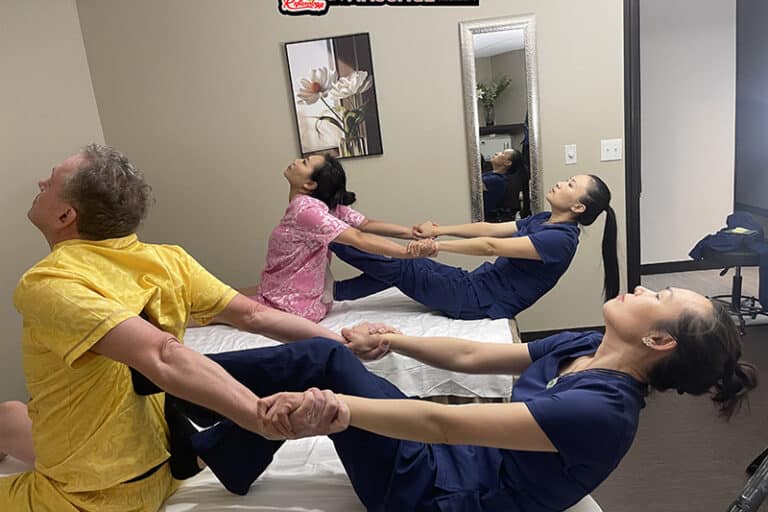
Our combination massage, covering feet, shoulders, neck, and back, draws from various techniques to deliver comprehensive relief. And our Thai massage sessions incorporate passive stretching to promote well-being in ways that neither pure Chinese nor Western methods address on their own.
The key is being honest about your goals and open with your therapist about your experience. A skilled practitioner can adjust their approach based on how your body responds.
Conclusion
The differences between Chinese and Western massage run deep, from foundational philosophy to hands-on technique to treatment outcomes. Chinese massage works with energy flow and treats the body as an interconnected whole, while Western methods focus on muscular anatomy and targeted physical results.
Neither tradition has a monopoly on effectiveness. What matters is finding the approach that resonates with your body and addresses your specific concerns. For some people, that’s the energy-focused work of Chinese massage. For others, it’s the anatomically precise techniques of Western bodywork. And for many, the answer is some combination of both.
At Li’s Massage Therapy and Reflexology, our highly qualified massage therapists specialize in numerous types of massage and health-promoting touch. We’re here to help you relieve pain and stress and restore physical and psychological wellness, whatever methods work best for your unique situation. If you’re in Centennial or Highlands Ranch and curious about experiencing the difference that Chinese massage techniques can make, call us today or book an appointment online. Your body, and your Qi, will thank you.